
Dagtochten vanaf het Comomeer: hoe u de beste dagtochten in Noord-Italië kunt ontdekken
Als jullie al aan het Comomeer verblijven en verder willen ontdekken zonder van hotel te wisselen, is deze gids voor jullie bedoeld. Vanaf het meer kunnen jullie in één dag grote culturele steden, andere iconische meren en zelfs alpine spoorlijnen in Zwitserland bereiken, om elke avond terug te keren naar dezelfde accommodatie. De sleutel is het kiezen van realistische dagtrips, afgestemd op het openbaar vervoer en passend bij jullie reisstijl: zelfstandig, met gids of een evenwichtige mix.
In deze gids
- 01Overzicht
- 02Planningsregels
- 03Milaan
- 04Bergamo
- 05Lugano
- 06Bellinzona
- 07Lago Maggiore & de Borromeïsche Eilanden
- 08Tirano & de Valtellina
- 09Bernina-route naar St. Moritz
- 10Verona
- 11Parma
- 12Openbaar vervoer versus auto
- 13Begeleide tours versus zelf doen
- 14Veelgemaakte fouten om te vermijden
- 15Veelgestelde vragen over dagtochten vanaf het Comomeer
Dit is geen overzicht van nabijgelegen dorpen rond het Comomeer. De gids richt zich uitsluitend op interregionale en internationale dagtrips vanaf het Comomeer, naar bestemmingen zoals Milaan, Bergamo, Lugano, het Lago Maggiore, Tirano en de Valtellina, en de Bernina-route naar St. Moritz. Jullie vinden hier praktische logistieke informatie, voorgestelde routes, eerlijke voor- en nadelen en duidelijke beslisregels, zodat dagtrips goed georganiseerd aanvoelen en niet gehaast.
Bouw je dag op het meer
Keten verschillende dorpen op één dag met echte veerbootverbindingen.
Overzicht: hoe kies je de juiste dagtrip
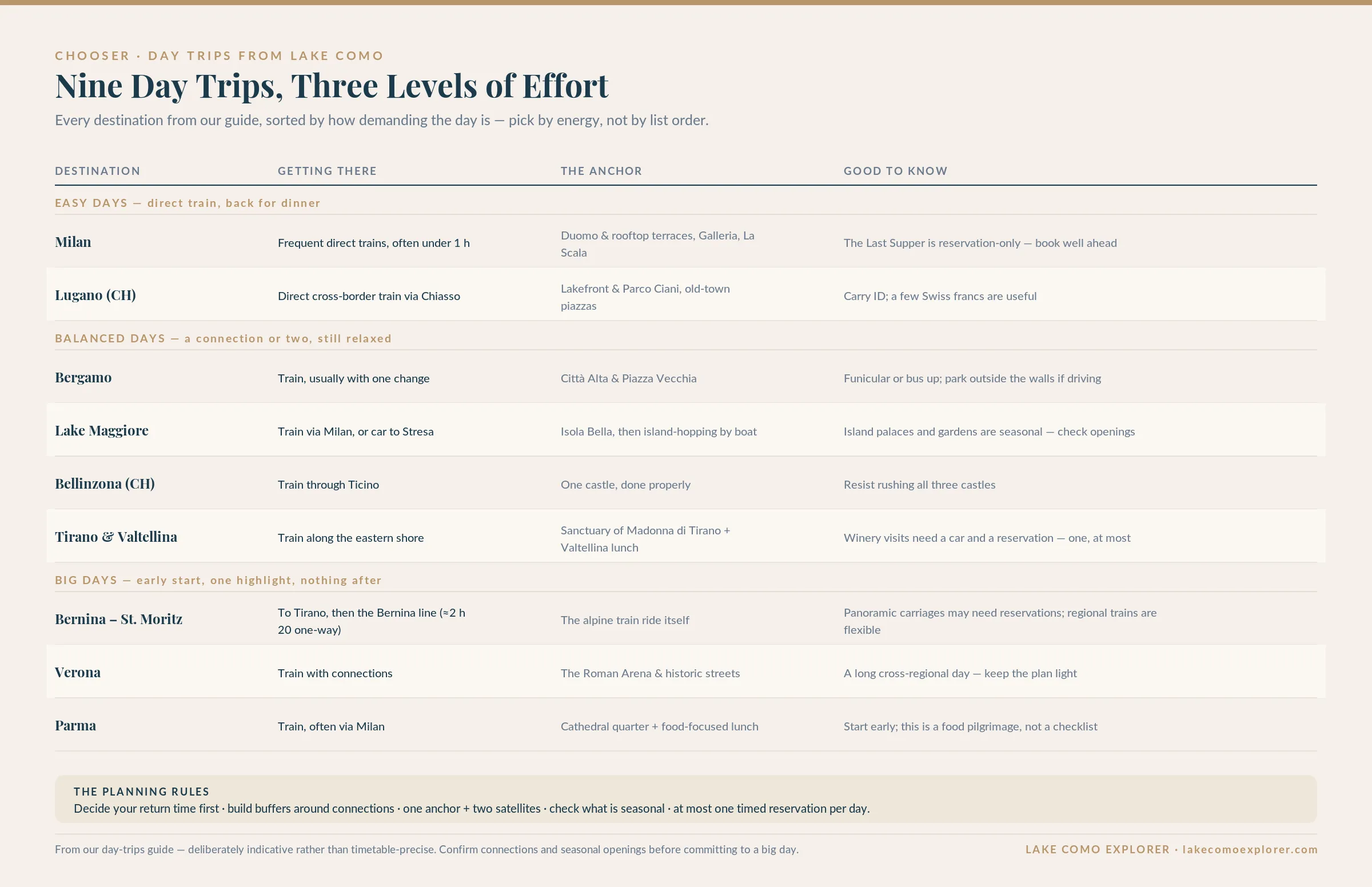
De beste dagtrips vanaf het Comomeer hangen af van drie factoren: jullie uitvalsbasis (waar jullie aan het meer verblijven), jullie tolerantie voor lange reisdagen en de ervaring die jullie het meest zoeken — stedelijke cultuur, alpine landschappen, een ander meer of een verandering naar een Zwitserse sfeer.
Gebruik dit eenvoudige besliskader:
- Easy day (low logistics, high comfort): choose a direct train destination such as Milan or Lugano. You can leave after breakfast and still be back for dinner without stress.
- Balanced day (more variety, still realistic): choose Bergamo or Lake Maggiore. Expect connections and slightly longer transfers, but the experience feels meaningfully different from Lake Como.
- Big day (long, unforgettable, very early start): choose the Bernina route to St. Moritz. This is a full commitment day with early trains and careful planning, but it delivers a once-in-a-lifetime level of scenery.
Jullie uitvalsbasis is belangrijk. Verblijven jullie aan de zuidkant van het meer, dan hebben jullie doorgaans de snelste toegang tot belangrijke spoorverbindingen en internationale treinen. Verblijven jullie in het middengedeelte van het meer of aan de oostelijke oever, dan zijn al deze trips nog steeds mogelijk, maar moet extra tijd worden ingepland om een groot spoorwegknooppunt te bereiken (meestal per trein naar een groter station). In de praktijk betekent dit eerder vertrekken en voldoende buffer inbouwen.
Planningsregels: timing, tickets en realistisch tempo
Dagtrips slagen of mislukken door timing. Noord-Italië en Zuid-Zwitserland zijn prima in één dag te doen, maar alleen als jullie een paar praktische regels accepteren.
Regel 1: bepaal eerst je terugkeertijd
Voordat jullie bepalen wat jullie willen zien, beslis eerst wanneer jullie terug willen zijn aan het Comomeer. Veel reizigers onderschatten hoe waardevol een rustige terugreis is, vooral na een dag in de stad. Willen jullie aan het meer dineren, plan dan een terugkeer in de late namiddag of vroege avond. Geven jullie de voorkeur aan een later diner, dan kan een latere terugkeer, maar alleen als het treinschema dat toelaat.
Regel 2: bouw tijdsbuffer in rond overstappen
Zodra jullie moeten overstappen, wordt een dagtrip minder vergevingsgezind. Bouw buffer in voor oriëntatie op het station, perronwissels en kleine vertragingen. Voor een eenvoudige dag geven jullie best prioriteit aan bestemmingen met rechtstreekse treinen of minimale overstappen. Voor een complexere dag (Bernina-route) is buffertijd niet onderhandelbaar.
Regel 3: gebruik “één ankerpunt + twee satellieten”
Een duidelijke structuur voorkomt gehaaste routes:
- Anchor: the main highlight (Duomo in Milan, Città Alta in Bergamo, Parco Ciani in Lugano, Isola Bella on Lake Maggiore, the Bernina train itself).
- Satellite 1: a second key stop that complements the anchor (a museum, viewpoint, neighbourhood, or garden).
- Satellite 2: a flexible, optional stop you can skip if timing slips (shopping street, café area, short boat ride, or extra museum).
Regel 4: controleer wat seizoensgebonden is
Sommige ervaringen zijn sterk seizoensgebonden. De eilandpaleizen en tuinen aan het Lago Maggiore hebben doorgaans seizoensgebonden openingstijden. Bergzichten zijn er altijd, maar in de winter zijn de dagen korter en kan het weer panoramische routes beïnvloeden. In het hoogseizoen verhogen drukte en wachtrijen jullie ‘verborgen tijdskosten’.
Regel 5: houd de ticketstrategie eenvoudig
Voor de meeste dagtrips kunnen jullie treintickets online of op het station kopen. Voor tijdgebonden ervaringen (Het Laatste Avondmaal in Milaan, panoramawagons op de Bernina-route, bepaalde museumbezoeken) is vooraf reserveren aan te raden. Willen jullie niet vastzitten aan vaste vertrektijden, kies dan voor flexibele tickets en vermijd het overboeken van activiteiten met een vaste tijd.
Milaan: cultuur, bezienswaardigheden, winkelen en aperitief
Milaan is de gemakkelijkste grote stad voor een dagtrip vanaf het Comomeer en de optie die in elk seizoen het meest betrouwbaar werkt. De treinreis is kort, de stad biedt een hoge concentratie aan impactvolle bezienswaardigheden, en jullie kunnen de dag afstemmen op jullie prioriteiten: architectuur, kunst, design, winkelen of simpelweg sfeer.
Hoe er te komen
Vanaf het Comomeer rijden er doorgaans de hele dag door frequente treinen naar Milaan. De reistijden verschillen per verbinding en route, maar een snelle rechtstreekse trein doet er vaak minder dan een uur over. Eenmaal aangekomen maakt de metro van Milaan het gemakkelijk om je door de stad te verplaatsen, en veel belangrijke bezienswaardigheden zijn te voet bereikbaar als jullie per wijk plannen.
Het meest geschikt voor
- Eerste bezoekers die een “grote-stad-contrast” met het meer willen ervaren
- Liefhebbers van architectuur en iconische bezienswaardigheden (Duomo, Galleria)
- Musea, galerieën en designcultuur
- Winkelen en aperitief
Realistische dagplanning (evenwichtig, niet gehaast)
Morning (Anchor): Start at the Duomo area. Visit the cathedral and, if weather is clear, go up to the rooftop terraces. The terraces are one of the most memorable Milan experiences because they are both architectural and panoramic.
Midday (Satellite 1): Walk through the Galleria Vittorio Emanuele II and continue toward La Scala. If you are interested, add a museum visit; if not, use this time for a relaxed lunch and street-level exploration.
Namiddag (kies één optie):
- Art option: Santa Maria delle Grazie for “The Last Supper” (only if you have a reservation) plus a calm stroll nearby.
- History option: Castello Sforzesco and Parco Sempione for a mix of city history and green space.
- Designoptie: A design district walk (choose one neighbourhood rather than attempting several).
Evening (Satellite 2): Navigli for aperitivo and canal atmosphere. Then return to the station for your train back to Lake Como.
Praktische tips voor Milaan
- Probeer niet elke beroemde bezienswaardigheid te “verzamelen”. Milaan beloont een doordacht tempo meer dan checklist-toerisme.
- Beperk je tot maximaal één reservering met vaste tijd (bijvoorbeeld Het Laatste Avondmaal). Te veel vaste tijdsloten zorgen voor stress.
- Plan jullie terugreis vóór de aperitivo in de avond, zodat jullie niet op het laatste moment dienstregelingen hoeven uit te pluizen.
Bergamo: middeleeuwse bovenstad en panoramische uitzichten
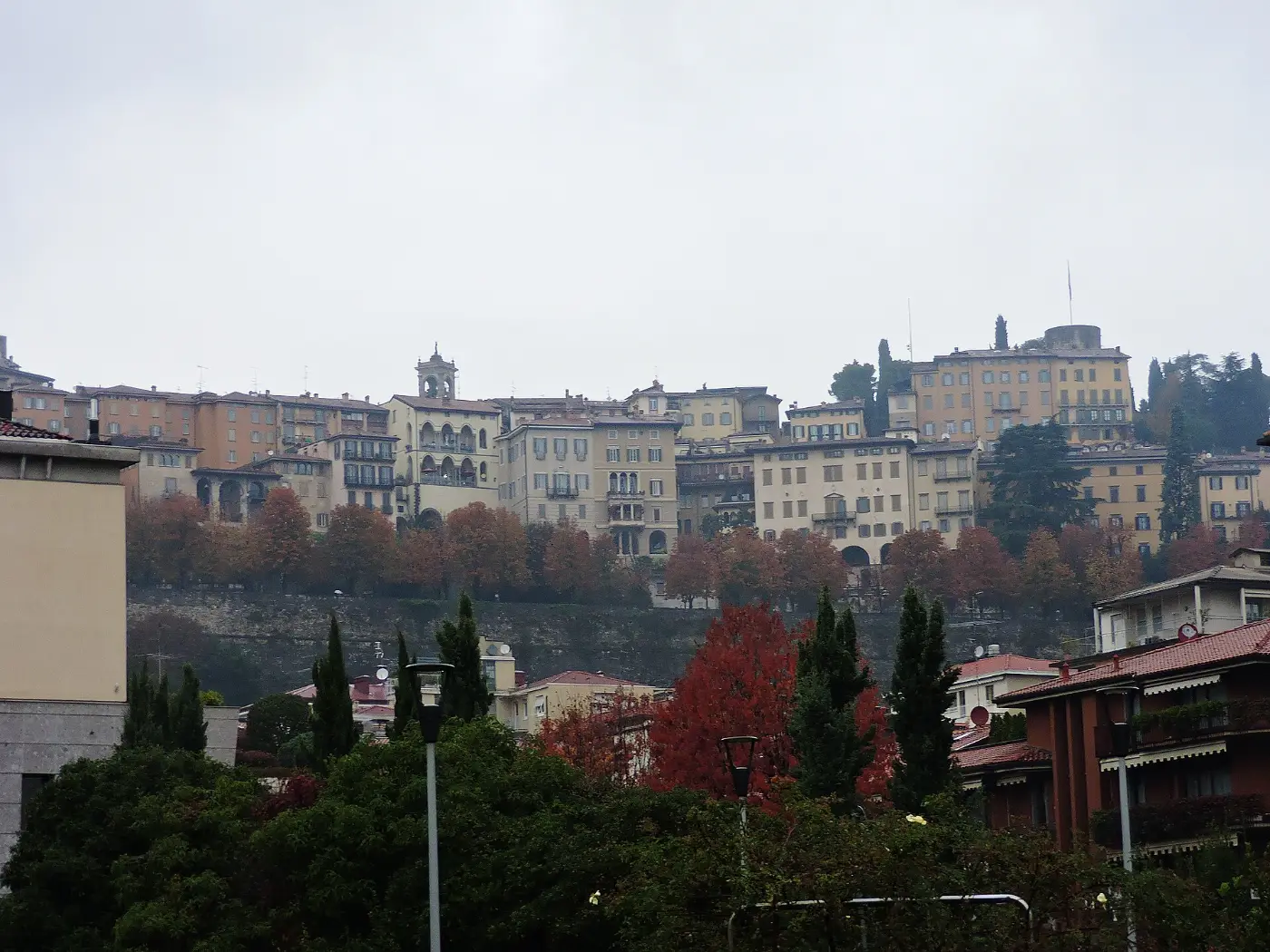
Bergamo is een van de meest lonende dagtrips voor reizigers die sfeer, historische gelaagdheid en panoramische uitzichten zoeken, zonder de intensiteit van een grote metropool. De bovenstad (Città Alta) voelt als een op zichzelf staande historische wereld boven de moderne stad, met geplaveide steegjes, elegante pleinen en uitzichtpunten langs de Venetiaanse muren.
Hoe er te komen
Bergamo is bereikbaar per trein (vaak met minstens één overstap) of met de auto. Eenmaal aangekomen is het het prettigst om naar de Città Alta te gaan en daar het grootste deel van de tijd door te brengen. De benedenstad is aangenaam, maar de bovenstad is de kenmerkende ervaring.
Het meest geschikt voor
- Reizigers die de sfeer van een historische heuvelstad willen ervaren zonder diep het platteland in te gaan
- Panoramische uitzichten en fotogenieke straten
- Een rustiger alternatief voor Milaan
Realistische dagplanning (evenwichtig, niet gehaast)
Morning (Anchor): Go straight to Città Alta. Start with the main square area (Piazza Vecchia) and the surrounding historic buildings. The atmosphere here is the highlight—move slowly and let the city reveal itself.
Midday (Satellite 1): Visit the Basilica di Santa Maria Maggiore and the Colleoni Chapel. Then enjoy a traditional lunch in a classic osteria.
Afternoon (Satellite 2): Walk along the Venetian walls and viewpoints. If you have time and energy, add a bell tower climb or a small museum, but keep it optional. Return to the lake before the evening becomes rushed.
Praktische tips voor Bergamo
- Richt jullie op de Città Alta. Proberen om “beide delen evenveel te doen” verwatert de dag.
- Draag comfortabele schoenen — stenen straten en hellingen horen bij de ervaring.
- Als jullie met de auto komen, parkeer dan buiten het historische centrum en gebruik de openbare toegangsmiddelen (kabelbaan of bus).
Lugano: Zwitserse elegantie aan het meer, parken en uitzichtpunten
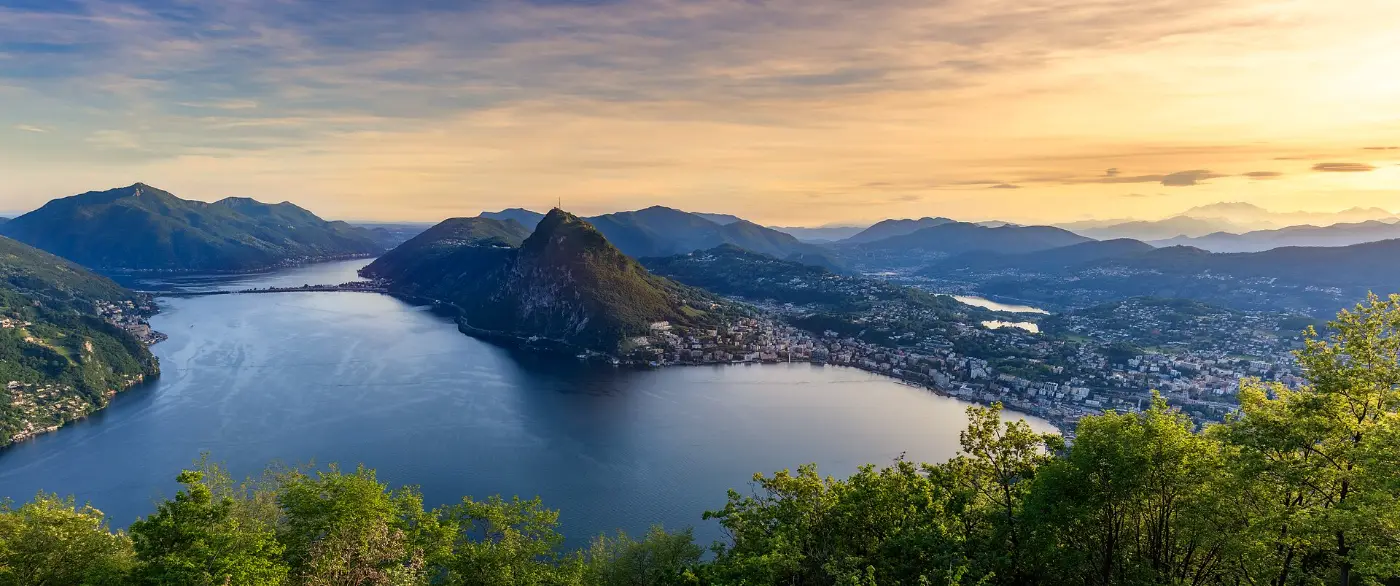
Lugano is de meest moeiteloze internationale dagtrip vanaf het Comomeer. De treinreis is kort, taal en keuken voelen vertrouwd aan, maar de organisatie en sfeer zijn duidelijk Zwitsers. Jullie ervaren een verzorgde stad aan het meer, met uitstekende parken, uitzichtpunten en een verfijnd tempo.
Hoe er te komen
Vanaf het Comomeer wordt Lugano meestal bereikt met een rechtstreekse grensoverschrijdende trein via Chiasso. De reistijd ligt vaak ruim onder een uur, waardoor dit echt een dag is om “na het ontbijt te vertrekken en voor het diner terug te zijn”. Neem een geldig identiteitsbewijs voor internationaal reizen mee, ook als er geen routinematige controles zijn.
Het meest geschikt voor
- Reizigers die een buitenlandgevoel willen zonder een lange reis
- Promenades langs het meer, parken en ontspannen stadswandelingen
- Uitzichtpunten bereikbaar met funiculars of korte liften
Realistische dagplanning (evenwichtig, niet gehaast)
Morning (Anchor): Walk the lakefront and Parco Ciani. This park is one of Lugano’s most enjoyable spaces—open lawns, lakeside paths, and framed views of mountains across the water.
Midday (Satellite 1): Explore the old town and central piazzas. Choose a simple lunch—either a classic café meal or a local spot that mixes Italian flavour with Swiss precision.
Afternoon (Satellite 2): Add one viewpoint experience if the weather is clear. Lugano’s surrounding hills can deliver wide panoramas that feel very “alpine” without requiring a major hike. Keep this optional: if clouds roll in, stay in the city and enjoy the atmosphere instead.
Praktische tips voor Lugano
- Neem een betaalkaart mee, maar houd ook een klein bedrag aan Zwitserse franken bij de hand als jullie voor kleine aankopen liever lokale valuta gebruiken.
- Plan niet te strak. Lugano komt het best tot zijn recht wanneer jullie rustig bewegen en het ritme van het meer volgen.
- Als de weersverwachting slecht is, vervang het uitzichtpunt door musea, cafés en een langere wandeling door de oude stad.
Bellinzona: kastelen en een compacte Zwitserse oude stad
Als jullie het idee van Zwitserland aanspreekt maar iets historischers en compacters zoeken dan Lugano, is Bellinzona een uitstekende keuze. De absolute blikvanger is het trio kastelen, indrukwekkend tegen het decor van het dal. De stad is klein, goed te voet te verkennen en ideaal voor reizigers die een duidelijk dagthema willen: kastelen, uitzichtpunten en een verzorgde Zwitsers-Italiaanse sfeer.
Hoe er te komen
Bellinzona is per trein bereikbaar via Ticino. Het werkt het best als een directe dagtrip per spoor: kom aan, focus op de kastelen en de oude stad, en keer terug zonder te veel extra stops toe te voegen.
Het meest geschikt voor
- Geschiedenisliefhebbers en uitzichtzoekers
- Reizigers die een rustige Zwitserse dag met een duidelijk thema zoeken
- Korte wandelingen en kasteelpaden in plaats van winkelen of musea
Aanbevolen route
Morning (Anchor): Choose one major castle as your anchor and explore it thoroughly rather than rushing three. Read the signage, walk the walls, and enjoy the elevated views.
Midday (Satellite 1): Lunch in the old town. Keep it simple and local.
Afternoon (Satellite 2): If energy and time allow, add a second castle or a viewpoint walk. Then return toward the lake with buffer time for trains.
Lago Maggiore & Borromeïsche Eilanden: tuinen, paleizen en eilandhoppen
Het Lago Maggiore heeft een heel ander karakter: bredere oevers, elegante badplaatsen en de beroemde Borromeïsche Eilanden met paleizen en tuinen. Het is een van de beste dagtochten voor reizigers die houden van aangelegde landschappen en historische interieurs. Ook voelt het duidelijk anders aan dan het Comomeer: ander licht, een andere schaal en een ander tempo.
Hoe kom je er: The classic strategy is to reach Stresa and then use boats to island-hop. Getting to Stresa is possible by train (often via Milan) or by car. Once you arrive, the experience becomes very straightforward: buy boat tickets and move between islands at your chosen pace.
Ideaal voor: gardens, architecture, and romantic lake scenery; a “second lake” day that feels curated and elegant; travellers who enjoy slow walking, photo stops, and scenic boat rides.
Realistic full-day itinerary:
Morning (Anchor): Take a boat to Isola Bella and focus on the palace and gardens. This is the headline experience—give it real time and do not rush.
Midday (Satellite 1): Head to Isola dei Pescatori for lunch and a gentle walk through the tiny village lanes. This is a calmer, human-scale contrast to the formal grandeur of Isola Bella.
Afternoon (Satellite 2): If energy and opening hours allow, add Isola Madre for botanical gardens, then return to Stresa and begin your trip back to Lake Como.
Practical tips for Lake Maggiore: Check seasonal openings for the palaces and gardens before you commit to the day. In peak season, arrive earlier to avoid queues for boats and ticket lines. Do not attempt to add extra towns “because you are already there”—lake days become stressful when you overextend.
Tirano en de Valtellina: alpine smaken en valleilandschappen
Als je op zoek bent naar een ervaring die lokaler aanvoelt en minder “toeristisch gepolijst” is, dan is de Valtellina-vallei een uitstekende keuze. Dit is een alpine regio in Lombardije, bekend om berglandschappen, terraswijngaarden en stevige culinaire tradities. Tirano is het klassieke vertrekpunt, omdat het zowel een historische stad is als de toegangspoort tot de Bernina-route.
Hoe kom je er: Tirano can be reached by train along the eastern side of the region or by car through the valley roads. It is a longer day than Milan or Lugano, but much less logistically complex than doing the full Bernina route to St. Moritz. If you want the “alpine valley” feeling without a full Switzerland commitment, Tirano and Valtellina deliver.
Ideaal voor: travellers who value authentic regional food and slower pacing; mountain landscapes and valley scenery; wine culture and rustic local identity.
Realistic full-day itinerary:
Morning (Anchor): Arrive in Tirano and explore the historic centre. Visit the Madonna di Tirano sanctuary and enjoy the architectural contrast to the lake towns.
Midday (Satellite 1): Lunch with a Valtellina signature dish. This region is best experienced through food as much as scenery.
Afternoon (Satellite 2): Add one structured experience: a short vineyard stop (if you have a car and a reservation), a scenic walk, or a relaxed café hour. Then return toward Lake Como with buffer time.
Practical tips for Valtellina: If you plan a wine tasting, reserve in advance and keep it to one winery to avoid timing stress. Mountain weather changes quickly—dress in layers even when the lake is warm. This is not the day for a tight schedule: let the valley feel slower.
Bernina-route naar St. Moritz: de iconische alpentrein
De Bernina-route is de meest spectaculaire dagtocht die je vanuit het Comomeer kunt maken. Het is ook de tocht die het vaakst misgaat wanneer reizigers de timing onderschatten. Goed uitgevoerd is het een onvergetelijke ervaring: een complete alpiene treinreis die hoog de bergen in voert, zonder technische wandelingen of een meerdaags programma.
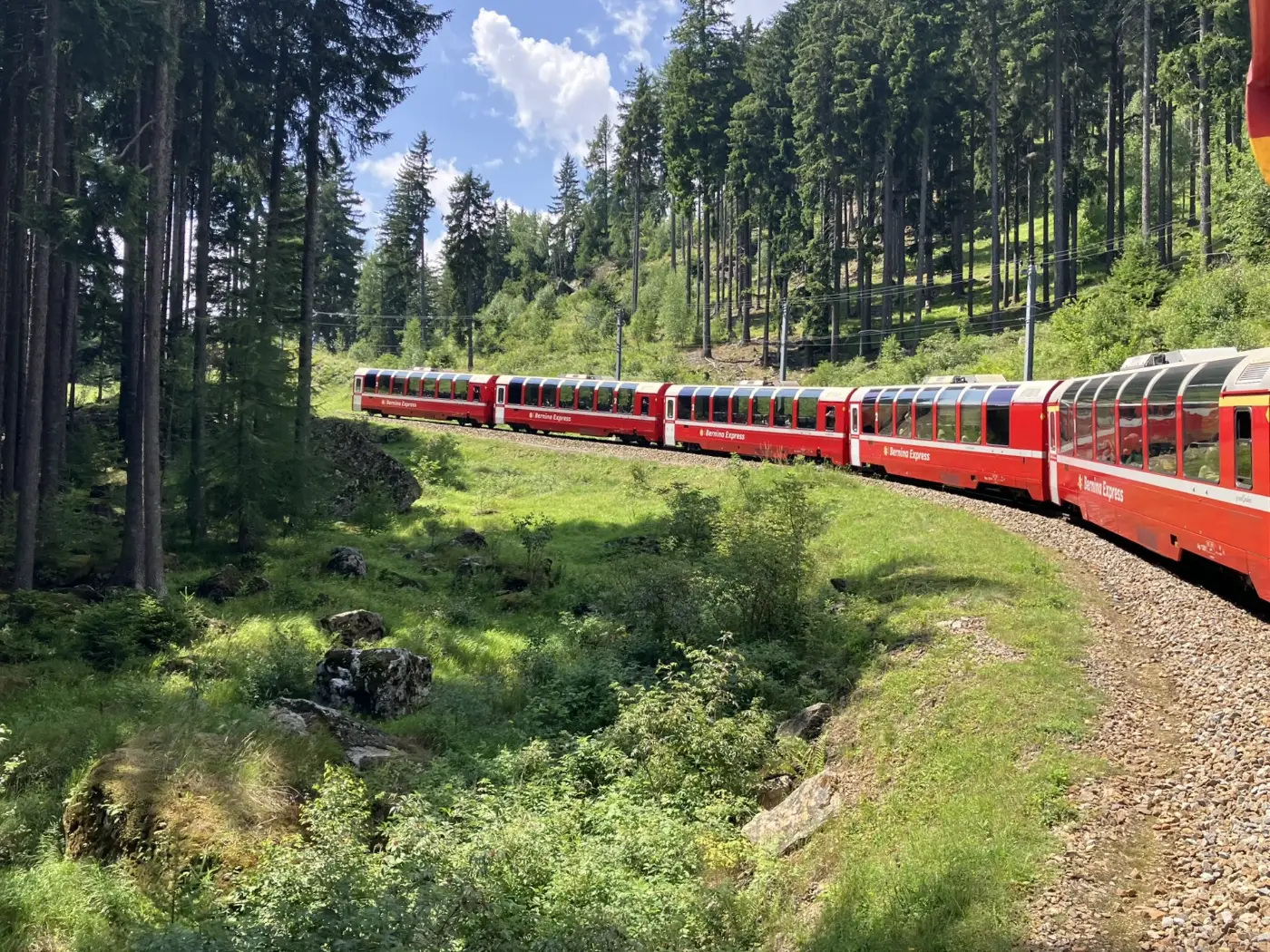
Het kernidee is eenvoudig: bereik Tirano, neem de Bernina-lijn naar St. Moritz, geniet van een kort bezoek en keer via dezelfde route terug. De uitvoering vraagt discipline: vroeg vertrekken, ruime tijdsmarges aanhouden en realistisch blijven dat de treinreis het hoofdmoment is, niet de tijd in St. Moritz.
Hoe kom je er: Step one is reaching Tirano. Step two is boarding the Bernina line. The one-way rail journey on the Bernina line is typically around 2 hours and 20 minutes. If you choose panoramic carriages on a dedicated tourist service, you may need reservations; if you choose regular regional trains, you usually get more flexibility and more frequent departures. Both follow the same spectacular route.
Ideaal voor: travellers who want a once-in-a-lifetime scenic experience; alpine views, glaciers, viaducts, and dramatic landscapes; people happy to prioritise the journey over a long stop at the destination.
Realistic full-day itinerary (the version that actually works):
Early morning: Leave Lake Como early and arrive in Tirano with buffer time. Do not plan a long breakfast in Tirano. This is a logistics day.
Late morning to early afternoon (Anchor): Ride the Bernina line to St. Moritz. Sit on the best-view side if you can, but do not obsess: the route is scenic from both sides, and there are multiple visual peaks.
Afternoon (Satellite 1): In St. Moritz, do one simple experience: a lakefront walk and a coffee, or a short town stroll. Keep it calm. Your return still matters.
Late afternoon to evening (Satellite 2): Take the return train to Tirano and continue back to Lake Como. This is where buffer time saves you from stress.
Practical tips for the Bernina day: This is the day to avoid stacking extra stops—the train ride is the headline. Weather changes the experience: clear days deliver maximum drama; cloudy days can still be beautiful but less panoramic. If you prefer less risk, consider a guided tour that manages transfers and timing; if you prefer freedom, choose regional trains for flexibility.
Verona: Romeins amfitheater en elegante historische straten
Verona is een langere, interregionale dagtrip, maar beloont reizigers die op zoek zijn naar een verzorgde historische stad met Romeins erfgoed en elegante straten. De Romeinse arena is een van de meest iconische amfitheaters van Italië en blijft het bepalende symbool van Verona. Naast de klassiekers ligt de echte kracht van de stad in de sfeer: stenen bruggen, riviergezichten en een stadscentrum dat is gemaakt om te voet te verkennen.
Hoe kom je er: Verona is typically reached by train with connections or by car along major routes. It works best for travellers who are comfortable with a long day and who want a single destination that is “all city,” with no additional complexity once you arrive.
Suggested itinerary:
Morning (Anchor): Arena area and the core historic streets around it.
Midday (Satellite 1): River walk and one major church or viewpoint.
Afternoon (Satellite 2): A flexible neighbourhood stroll and relaxed café time, then return to Lake Como.
Parma: eetcultuur, architectuur en slow city-charme
Parma is een dagtrip voor reizigers die op zoek zijn naar een zachtere, rustigere stadservaring, waarbij smaak en sfeer belangrijker zijn dan een intens afvinkprogramma. Parma staat internationaal bekend om zijn eetcultuur, maar biedt daarnaast ook een verfijnd historisch centrum, elegante pleinen en een kalm tempo dat duidelijk verschilt van zowel Milaan als het meer.
Hoe kom je er: Parma is typically reached by train (often via Milan) or by car. Because it is farther than Milan or Bergamo, it works best if you start early and keep your plan simple once you arrive: one historic core walk, one food-focused experience, one relaxed break, and then return.
Suggested itinerary:
Morning (Anchor): Historic centre walk with the cathedral area as a focal point.
Midday (Satellite 1): A food-focused lunch and a short gourmet shopping stop.
Afternoon (Satellite 2): A park stroll or a museum, then begin the return.
Openbaar vervoer of auto: wat werkt in de praktijk het best
Beide benaderingen werken vanuit het Comomeer, maar passen bij verschillende soorten reizen.
When public transport is best: City days such as Milan and Lugano are ideal by train—you avoid traffic, parking, and restricted zones. Trains also reduce stress for high-demand destinations where parking is difficult or expensive. For solo travellers or couples, the cost-benefit of a car often does not pay off for small groups.
When a car is best: A car can reduce connection complexity for a Lake Maggiore day depending on your base and route. It is also useful for Valtellina explorations if you want vineyards or small valley stops, and it suits travellers who prefer custom pacing: sunrise starts, flexible photo stops, and independence from timetables.
Reality check: the hidden costs of driving
Driving in Northern Italy can be efficient, but it also introduces friction: tolls, parking searches, city access restrictions, and the mental load of navigation. For many travellers, the train is simply more pleasant. A good strategy is mixed mode: do city and Switzerland days by train, and reserve driving for “countryside flexibility” days.
Geleide tours of zelf doen: wanneer een tour de moeite waard is
Een evenwichtige aanpak werkt meestal het best: regel de eenvoudige dagen zelfstandig en overweeg begeleide tours voor de complexere dagen, wanneer die daadwerkelijk risico’s verminderen.
DIY works best when: the destination is direct by train (Milan, Lugano); you want freedom to change plans based on weather or mood; you prefer slow pacing, long lunches, and flexible return times.
Guided tours are worth it when: the day includes multiple transfers and tight timing (the Bernina day from certain bases); you want tickets and logistics handled end-to-end with minimal thinking; you value curated commentary and a “best-of” route without research.
Een van de meest voorkomende planningsfouten is het boeken van een begeleide tour voor een bestemming die al eenvoudig per trein te bereiken is. Bewaar begeleide tours voor dagen waarop ze echte meerwaarde bieden, niet alleen structuur.
Veelgemaakte fouten om te vermijden
Overstacking highlights: The fastest way to ruin a day trip is adding “just one more stop.” Use one anchor, two satellites, and protect your return.
Ignoring seasonality: Gardens, islands, and some attractions have seasonal opening periods. Always verify before committing.
No buffer time: Connections are where stress happens. Buffer time is not wasted time—it is the difference between calm travel and panic.
Wrong day for the wrong weather: Save panoramic trains and viewpoint days for clear forecasts when possible. Use cloudy days for cities and museums.
Late starts for big days: The Bernina route is not an afternoon idea. If you cannot start early, choose a different day trip.
Veelgestelde vragen over dagtochten vanaf het Comomeer
How many day trips should I plan during a short Lake Como stay?
If you have three to five nights on Lake Como, plan two day trips beyond the lake and keep at least one full day for a slower lakeside rhythm. A strong mix is one city day (Milan or Bergamo) plus one “special experience” day (Lugano or Lake Maggiore). If you want the Bernina route, make it the single “big day” and do not add another heavy day immediately after.
Which day trip is the easiest if I want zero stress?
Lugano is usually the simplest international day: short train ride, compact city, and a relaxed pace. Milan is also easy logistically, but it can feel intense due to crowds and the scale of the city. If you want calm, choose Lugano.
Is the Bernina route to St. Moritz realistic as a day trip?
Yes, but it is a long day and it must be planned properly. The train journey is the main event, and your time in St. Moritz will be limited. If you start late or try to add extra stops, the day becomes stressful. If you want an unforgettable scenic experience and you are comfortable with an early start, it is worth it.
Should I rent a car for these day trips?
Not necessarily. Trains are excellent for city days and for Switzerland. A car is most useful when you want countryside flexibility (for example, deeper Valtellina stops or certain Lake Maggiore routing depending on your base). If you dislike driving, public transport will cover most classic day trips well.
Do I need a passport to go to Switzerland for the day?
You should carry valid identification for international travel. While there may not be routine border checks, you can still be asked for ID, especially on cross-border trains. Carry your passport or an appropriate national ID document.
What are the best months for day trips from Lake Como?
Late spring and early autumn are ideal for day trips: mild temperatures, comfortable walking conditions, and strong daylight. Summer works well but adds crowds and queues. Winter is calmer and atmospheric for cities, while alpine routes can be spectacular in snow—just remember that daylight is shorter and weather is more variable.
How do I choose between Milan and Bergamo?
Choose Milan if you want major landmarks, museums, shopping, and high-energy city life. Choose Bergamo if you want medieval atmosphere, panoramic viewpoints, and a calmer historic core that feels curated and walkable without being overwhelming.
How do I avoid the “rushed day trip” feeling?
Pick one anchor experience, add two optional satellites, and decide your return time before you start the day. Avoid stacking timed reservations, build buffers for transfers, and keep at least one “slow” moment (a long lunch, a park walk, a lakefront café). Those pauses are what make the day feel elegant rather than exhausting.