

Day Trips from Lake Como: How to Discover the Best Day Trips in Northern Italy
If you are already based on Lake Como and want to explore beyond the shoreline without changing hotels, this guide is designed for you. From the lake, you can reach major cultural cities, other iconic lakes, and even Switzerland’s alpine rail routes in a single day—then return to the same accommodation each evening. The key is choosing trips that are realistic, timed to public transport, and matched to your travel style: independent (DIY), guided, or a sensible mix of both.
In this guide
This is not a list of nearby villages on Lake Como. Instead, it focuses exclusively on cross-regional and international day trips from Lake Como—places like Milan, Bergamo, Lugano, Lake Maggiore, Tirano and the Valtellina, and the Bernina route to St. Moritz. You will find practical logistics, suggested itineraries, honest pros and cons, and clear decision rules so your day trips feel organised rather than rushed.
Build Your Day on the Lake
Chain several villages in one day using real ferry connections.
Overview: how to choose the right day trip
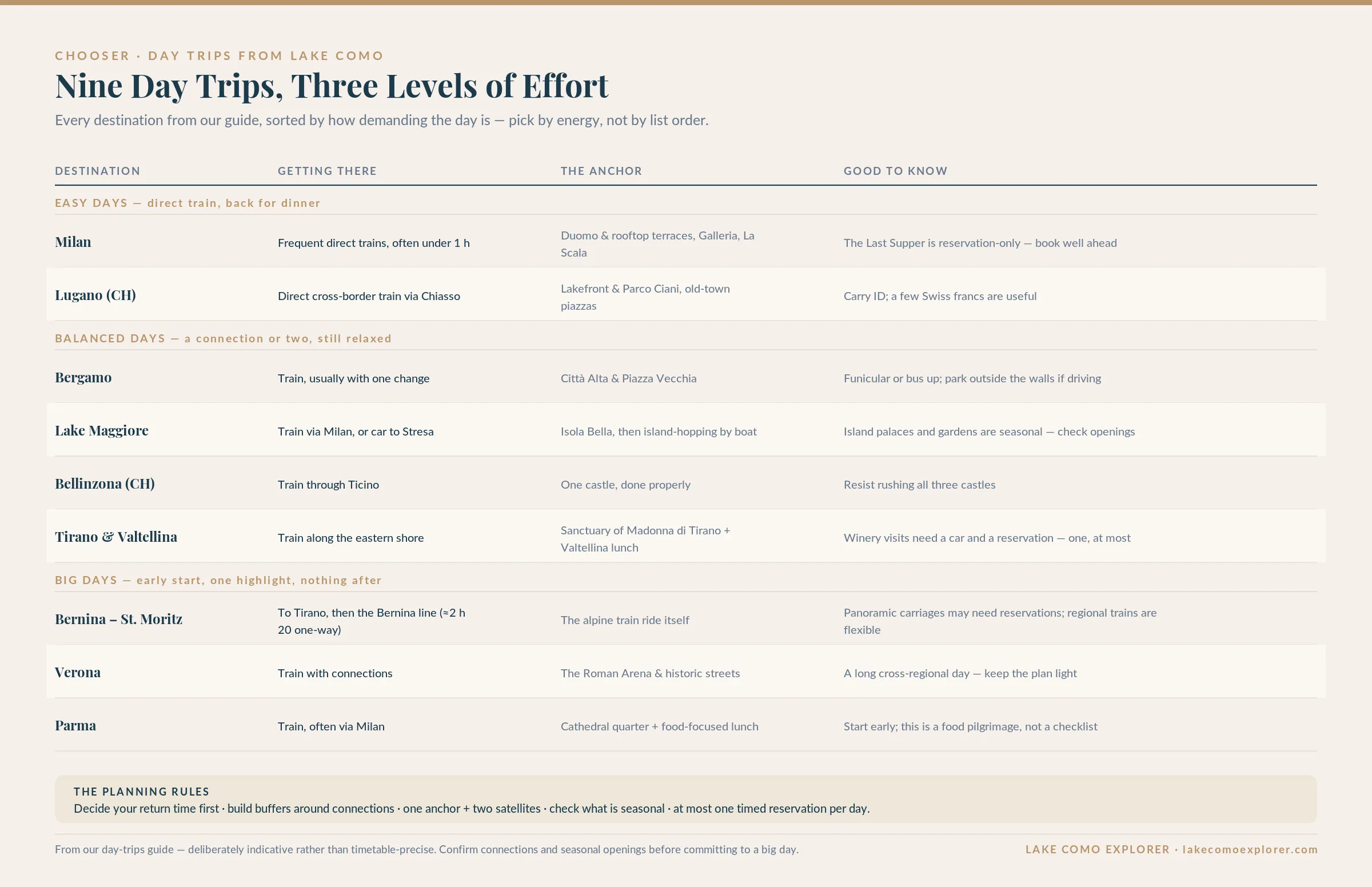
The best day trips from Lake Como depend on three variables: your base (where on the lake you are staying), your tolerance for long travel days, and the experience you want most—city culture, alpine scenery, another lake, or a Swiss-style change of atmosphere.
Use this simple decision framework:
- Easy day (low logistics, high comfort): choose a direct train destination such as Milan or Lugano. You can leave after breakfast and still be back for dinner without stress.
- Balanced day (more variety, still realistic): choose Bergamo or Lake Maggiore. Expect connections and slightly longer transfers, but the experience feels meaningfully different from Lake Como.
- Big day (long, unforgettable, very early start): choose the Bernina route to St. Moritz. This is a full commitment day with early trains and careful planning, but it delivers a once-in-a-lifetime level of scenery.
Your base matters. If you are staying near the southern end of the lake, you generally have the fastest access to major rail connections and cross-border trains. If you are staying mid-lake or on the eastern shore, you can still do all these trips, but you must allow extra time to reach a main rail hub (usually by train to a larger station). In practice, that means starting earlier and building in buffer time.
Planning rules: timing, tickets, and realistic pacing
Day trips succeed or fail on timing. Northern Italy and southern Switzerland are extremely doable in a day, but only if you accept a few practical rules.
Rule 1: Decide your “return time” first
Before you choose what to see, choose when you want to be back on Lake Como. Many travellers underestimate how valuable a calm return is—especially after a city day. If you want dinner on the lake, plan to be back in the late afternoon or early evening. If you enjoy a later dinner, you can return later, but only if the train schedule supports it.
Rule 2: Build buffers around connections
When you have to change trains, your day trip becomes less forgiving. Add buffer time for station navigation, platform changes, and minor delays. For a simple day, prioritise destinations with direct trains or minimal changes. For a complex day (Bernina route), treat buffer time as non-negotiable.
Rule 3: Use “one anchor + two satellites”
A clean structure prevents rushed itineraries:
- Anchor: the main highlight (Duomo in Milan, Città Alta in Bergamo, Parco Ciani in Lugano, Isola Bella on Lake Maggiore, the Bernina train itself).
- Satellite 1: a second key stop that complements the anchor (a museum, viewpoint, neighbourhood, or garden).
- Satellite 2: a flexible, optional stop you can skip if timing slips (shopping street, café area, short boat ride, or extra museum).
Rule 4: Check what is seasonal
Some experiences are strongly seasonal. Island palaces and gardens on Lake Maggiore typically have seasonal opening periods. Mountain views are always present, but winter days are shorter and weather can affect scenic routes. In high season, crowds and queues increase your “hidden time cost.”
Rule 5: Keep a simple ticket strategy
For most day trips, you can buy train tickets online or at the station. For time-sensitive experiences (The Last Supper in Milan, panoramic Bernina carriages, certain museum entries), book in advance. If you do not want to commit to fixed departure times, choose flexible train options and avoid overbooking timed attractions.
Milan: culture, landmarks, shopping, aperitivo
Milan is the easiest major city day trip from Lake Como and the one that most reliably works in any season. The train ride is short, the city is dense with high-impact sights, and you can tailor the day to your priorities: architecture, art, design, shopping, or simply atmosphere.
How to get there
From the Lake Como area, trains to Milan typically run frequently throughout the day. Travel times vary by service and route, but a fast direct journey is often under an hour. Once you arrive, Milan’s metro makes movement across the city straightforward, and many key sights are walkable if you plan your day around one district at a time.
Best for
- First-time visitors who want a “big city contrast” to the lake
- Architecture and landmark collectors (Duomo, Galleria)
- Museums, galleries, and design culture
- Shopping and aperitivo
Realistic full-day itinerary (balanced, not rushed)
Morning (Anchor): Start at the Duomo area. Visit the cathedral and, if weather is clear, go up to the rooftop terraces. The terraces are one of the most memorable Milan experiences because they are both architectural and panoramic.
Midday (Satellite 1): Walk through the Galleria Vittorio Emanuele II and continue toward La Scala. If you are interested, add a museum visit; if not, use this time for a relaxed lunch and street-level exploration.
Afternoon (Choose one):
- Art option: Santa Maria delle Grazie for “The Last Supper” (only if you have a reservation) plus a calm stroll nearby.
- History option: Castello Sforzesco and Parco Sempione for a mix of city history and green space.
- Design option: A design district walk (choose one neighbourhood rather than attempting several).
Evening (Satellite 2): Navigli for aperitivo and canal atmosphere. Then return to the station for your train back to Lake Como.
Practical tips for Milan
- Do not try to “collect” every famous sight. Milan rewards curated pacing more than checklist tourism.
- Keep one timed reservation max (for example, The Last Supper). Too many timed slots create stress.
- Plan your return route before evening aperitivo, so you are not navigating schedules last-minute.
Bergamo: medieval upper town and panoramic views
Bergamo is one of the most rewarding day trips for travellers who want atmosphere, historic texture, and panoramic viewpoints without the intensity of a major metropolis. The upper town (Città Alta) feels like a self-contained historic world above the modern city, with cobbled lanes, elegant squares, and viewpoints along the Venetian walls.

How to get there
Bergamo is reachable by train (often with at least one change) or by car. Once in Bergamo, the most enjoyable approach is to reach Città Alta and spend most of your time there. The lower town is pleasant, but the upper town is the signature experience.
Best for
- Travellers who want a historic hilltown feel without going deep into rural areas
- Panoramic views and photogenic streets
- A calmer alternative to Milan
Realistic full-day itinerary
Morning (Anchor): Go straight to Città Alta. Start with the main square area (Piazza Vecchia) and the surrounding historic buildings. The atmosphere here is the highlight—move slowly and let the city reveal itself.
Midday (Satellite 1): Visit the Basilica di Santa Maria Maggiore and the Colleoni Chapel. Then enjoy a traditional lunch in a classic osteria.
Afternoon (Satellite 2): Walk along the Venetian walls and viewpoints. If you have time and energy, add a bell tower climb or a small museum, but keep it optional. Return to the lake before the evening becomes rushed.
Practical tips for Bergamo
- Focus on Città Alta. Trying to “do both towns equally” dilutes the day.
- Wear comfortable shoes—stone streets and slopes are part of the experience.
- If you drive, park outside the historic core and use public access points (funicular or buses).
Lugano: Swiss lakeside elegance, parks, viewpoints
Lugano is the most effortless international day trip from Lake Como. The train ride is short, the language and food feel familiar, but the organisation and atmosphere shift into something distinctly Swiss. You get a clean, lakeside city experience with excellent parks, viewpoints, and a refined pace.

How to get there
From the Lake Como area, Lugano is commonly reached by direct cross-border train via Chiasso. Travel times are often well under an hour, making this a true “leave after breakfast, return for dinner” day. Bring valid identification for international travel, even if there are no routine checks.
Best for
- Travellers who want a foreign-country feel without a long journey
- Lakeside promenades, parks, and relaxed city walking
- Viewpoints via funiculars or short lifts
Realistic full-day itinerary
Morning (Anchor): Walk the lakefront and Parco Ciani. This park is one of Lugano’s most enjoyable spaces—open lawns, lakeside paths, and framed views of mountains across the water.
Midday (Satellite 1): Explore the old town and central piazzas. Choose a simple lunch—either a classic café meal or a local spot that mixes Italian flavour with Swiss precision.
Afternoon (Satellite 2): Add one viewpoint experience if the weather is clear. Lugano’s surrounding hills can deliver wide panoramas that feel very “alpine” without requiring a major hike. Keep this optional: if clouds roll in, stay in the city and enjoy the atmosphere instead.
Practical tips for Lugano
- Carry a card, but also keep a small amount of Swiss Francs if you prefer local currency for small purchases.
- Do not overplan. Lugano is best when you move slowly and enjoy the lakeside rhythm.
- If the forecast is poor, swap the viewpoint for museums, cafés, and a longer old-town walk.
Bellinzona: castles and a compact Swiss old town
If you like the idea of Switzerland but want something more historic and compact than Lugano, Bellinzona is an excellent alternative. The star attraction is its trio of castles, dramatic against the valley landscape. The town itself is small, walkable, and ideal for travellers who want a clear theme for the day: castles, viewpoints, and a tidy Swiss-Italian atmosphere.
How to get there
Bellinzona is reachable by train through Ticino. It works best as a direct rail day: arrive, focus on the castles and old town, and return without adding too many extra stops.
Best for
- History lovers and viewpoint seekers
- Travellers who want a calm Swiss day with a strong theme
- Short hikes and castle paths rather than shopping or museums
Suggested itinerary
Morning (Anchor): Choose one major castle as your anchor and explore it thoroughly rather than rushing three. Read the signage, walk the walls, and enjoy the elevated views.
Midday (Satellite 1): Lunch in the old town. Keep it simple and local.
Afternoon (Satellite 2): If energy and time allow, add a second castle or a viewpoint walk. Then return toward the lake with buffer time for trains.
Lake Maggiore & the Borromean Islands: gardens, palaces, lake-hopping
Lake Maggiore offers a different lake personality: broader shores, elegant resort towns, and the famous Borromean Islands with palaces and gardens. This is one of the best day trips for travellers who love landscaped beauty and historic interiors. It also feels distinct from Lake Como—different light, different scale, and a different rhythm.
How to get there: The classic strategy is to reach Stresa and then use boats to island-hop. Getting to Stresa is possible by train (often via Milan) or by car. Once you arrive, the experience becomes very straightforward: buy boat tickets and move between islands at your chosen pace.
Best for: gardens, architecture, and romantic lake scenery; a “second lake” day that feels curated and elegant; travellers who enjoy slow walking, photo stops, and scenic boat rides.
Realistic full-day itinerary:
Morning (Anchor): Take a boat to Isola Bella and focus on the palace and gardens. This is the headline experience—give it real time and do not rush.
Midday (Satellite 1): Head to Isola dei Pescatori for lunch and a gentle walk through the tiny village lanes. This is a calmer, human-scale contrast to the formal grandeur of Isola Bella.
Afternoon (Satellite 2): If energy and opening hours allow, add Isola Madre for botanical gardens, then return to Stresa and begin your trip back to Lake Como.
Practical tips for Lake Maggiore: Check seasonal openings for the palaces and gardens before you commit to the day. In peak season, arrive earlier to avoid queues for boats and ticket lines. Do not attempt to add extra towns “because you are already there”—lake days become stressful when you overextend.
Tirano & the Valtellina: alpine valley flavours and scenery
If you want an experience that feels more local and less “tourist-polished,” the Valtellina valley is an excellent choice. This is an alpine Lombardy region known for mountain landscapes, terraced vineyards, and hearty food traditions. Tirano is the classic base point because it is a historic town and also a gateway to the Bernina route.
How to get there: Tirano can be reached by train along the eastern side of the region or by car through the valley roads. It is a longer day than Milan or Lugano, but much less logistically complex than doing the full Bernina route to St. Moritz. If you want the “alpine valley” feeling without a full Switzerland commitment, Tirano and Valtellina deliver.
Best for: travellers who value authentic regional food and slower pacing; mountain landscapes and valley scenery; wine culture and rustic local identity.
Realistic full-day itinerary:
Morning (Anchor): Arrive in Tirano and explore the historic centre. Visit the Madonna di Tirano sanctuary and enjoy the architectural contrast to the lake towns.
Midday (Satellite 1): Lunch with a Valtellina signature dish. This region is best experienced through food as much as scenery.
Afternoon (Satellite 2): Add one structured experience: a short vineyard stop (if you have a car and a reservation), a scenic walk, or a relaxed café hour. Then return toward Lake Como with buffer time.
Practical tips for Valtellina: If you plan a wine tasting, reserve in advance and keep it to one winery to avoid timing stress. Mountain weather changes quickly—dress in layers even when the lake is warm. This is not the day for a tight schedule: let the valley feel slower.
Bernina route to St. Moritz: the iconic alpine train day
The Bernina route is the most dramatic day trip you can do from Lake Como. It is also the one that most often fails when travellers underestimate timing. Done well, it is unforgettable: a full alpine rail experience that climbs into high mountain scenery without requiring technical hiking or a multi-day itinerary.
The core concept is simple: reach Tirano, take the Bernina line up to St. Moritz, enjoy a short visit, and return the same way. The execution requires discipline: early start, strong buffer time, and a realistic expectation that the train ride is the main event, not the time in St. Moritz.
How to get there: Step one is reaching Tirano. Step two is boarding the Bernina line. The one-way rail journey on the Bernina line is typically around 2 hours and 20 minutes. If you choose panoramic carriages on a dedicated tourist service, you may need reservations; if you choose regular regional trains, you usually get more flexibility and more frequent departures. Both follow the same spectacular route.
Best for: travellers who want a once-in-a-lifetime scenic experience; alpine views, glaciers, viaducts, and dramatic landscapes; people happy to prioritise the journey over a long stop at the destination.
Realistic full-day itinerary (the version that actually works):
Early morning: Leave Lake Como early and arrive in Tirano with buffer time. Do not plan a long breakfast in Tirano. This is a logistics day.
Late morning to early afternoon (Anchor): Ride the Bernina line to St. Moritz. Sit on the best-view side if you can, but do not obsess: the route is scenic from both sides, and there are multiple visual peaks.
Afternoon (Satellite 1): In St. Moritz, do one simple experience: a lakefront walk and a coffee, or a short town stroll. Keep it calm. Your return still matters.
Late afternoon to evening (Satellite 2): Take the return train to Tirano and continue back to Lake Como. This is where buffer time saves you from stress.
Practical tips for the Bernina day: This is the day to avoid stacking extra stops—the train ride is the headline. Weather changes the experience: clear days deliver maximum drama; cloudy days can still be beautiful but less panoramic. If you prefer less risk, consider a guided tour that manages transfers and timing; if you prefer freedom, choose regional trains for flexibility.
Verona: Roman arena and elegant historic streets
Verona is a longer cross-regional day trip, but it rewards travellers who want a polished historic city with Roman heritage and graceful streets. The Roman Arena is one of the most iconic amphitheatres in Italy and remains a defining symbol of Verona. Beyond the classics, Verona’s real strength is atmosphere: stone bridges, river views, and a city centre designed for walking.
How to get there: Verona is typically reached by train with connections or by car along major routes. It works best for travellers who are comfortable with a long day and who want a single destination that is “all city,” with no additional complexity once you arrive.
Suggested itinerary:
Morning (Anchor): Arena area and the core historic streets around it.
Midday (Satellite 1): River walk and one major church or viewpoint.
Afternoon (Satellite 2): A flexible neighbourhood stroll and relaxed café time, then return to Lake Como.
Parma: food culture, architecture, and slow city charm
Parma is a day trip for travellers who want a softer, slower city experience, where the reward is taste and atmosphere rather than a high-intensity checklist. Parma is internationally associated with food culture, but it also offers a refined historic centre, elegant squares, and a calm rhythm that feels very different from both Milan and the lake.
How to get there: Parma is typically reached by train (often via Milan) or by car. Because it is farther than Milan or Bergamo, it works best if you start early and keep your plan simple once you arrive: one historic core walk, one food-focused experience, one relaxed break, and then return.
Suggested itinerary:
Morning (Anchor): Historic centre walk with the cathedral area as a focal point.
Midday (Satellite 1): A food-focused lunch and a short gourmet shopping stop.
Afternoon (Satellite 2): A park stroll or a museum, then begin the return.
Public transport vs car: what actually works best
Both approaches work from Lake Como, but they suit different trip types.
When public transport is best: City days such as Milan and Lugano are ideal by train—you avoid traffic, parking, and restricted zones. Trains also reduce stress for high-demand destinations where parking is difficult or expensive. For solo travellers or couples, the cost-benefit of a car often does not pay off for small groups.
When a car is best: A car can reduce connection complexity for a Lake Maggiore day depending on your base and route. It is also useful for Valtellina explorations if you want vineyards or small valley stops, and it suits travellers who prefer custom pacing: sunrise starts, flexible photo stops, and independence from timetables.
Reality check: the hidden costs of driving
Driving in Northern Italy can be efficient, but it also introduces friction: tolls, parking searches, city access restrictions, and the mental load of navigation. For many travellers, the train is simply more pleasant. A good strategy is mixed mode: do city and Switzerland days by train, and reserve driving for “countryside flexibility” days.
Guided tours vs DIY: when a tour is worth it
A balanced approach usually works best: do the simple days independently, and consider guided tours for the complex days where a tour genuinely reduces risk.
DIY works best when: the destination is direct by train (Milan, Lugano); you want freedom to change plans based on weather or mood; you prefer slow pacing, long lunches, and flexible return times.
Guided tours are worth it when: the day includes multiple transfers and tight timing (the Bernina day from certain bases); you want tickets and logistics handled end-to-end with minimal thinking; you value curated commentary and a “best-of” route without research.
One of the most common planning mistakes is booking a guided tour for a destination that is already simple by train. Save guided tours for the days where they provide real value, not just structure.
Common mistakes to avoid
Overstacking highlights: The fastest way to ruin a day trip is adding “just one more stop.” Use one anchor, two satellites, and protect your return.
Ignoring seasonality: Gardens, islands, and some attractions have seasonal opening periods. Always verify before committing.
No buffer time: Connections are where stress happens. Buffer time is not wasted time—it is the difference between calm travel and panic.
Wrong day for the wrong weather: Save panoramic trains and viewpoint days for clear forecasts when possible. Use cloudy days for cities and museums.
Late starts for big days: The Bernina route is not an afternoon idea. If you cannot start early, choose a different day trip.
FAQs about day trips from Lake Como
How many day trips should I plan during a short Lake Como stay?
If you have three to five nights on Lake Como, plan two day trips beyond the lake and keep at least one full day for a slower lakeside rhythm. A strong mix is one city day (Milan or Bergamo) plus one “special experience” day (Lugano or Lake Maggiore). If you want the Bernina route, make it the single “big day” and do not add another heavy day immediately after.
Which day trip is the easiest if I want zero stress?
Lugano is usually the simplest international day: short train ride, compact city, and a relaxed pace. Milan is also easy logistically, but it can feel intense due to crowds and the scale of the city. If you want calm, choose Lugano.
Is the Bernina route to St. Moritz realistic as a day trip?
Yes, but it is a long day and it must be planned properly. The train journey is the main event, and your time in St. Moritz will be limited. If you start late or try to add extra stops, the day becomes stressful. If you want an unforgettable scenic experience and you are comfortable with an early start, it is worth it.
Should I rent a car for these day trips?
Not necessarily. Trains are excellent for city days and for Switzerland. A car is most useful when you want countryside flexibility (for example, deeper Valtellina stops or certain Lake Maggiore routing depending on your base). If you dislike driving, public transport will cover most classic day trips well.
Do I need a passport to go to Switzerland for the day?
You should carry valid identification for international travel. While there may not be routine border checks, you can still be asked for ID, especially on cross-border trains. Carry your passport or an appropriate national ID document.
What are the best months for day trips from Lake Como?
Late spring and early autumn are ideal for day trips: mild temperatures, comfortable walking conditions, and strong daylight. Summer works well but adds crowds and queues. Winter is calmer and atmospheric for cities, while alpine routes can be spectacular in snow—just remember that daylight is shorter and weather is more variable.
How do I choose between Milan and Bergamo?
Choose Milan if you want major landmarks, museums, shopping, and high-energy city life. Choose Bergamo if you want medieval atmosphere, panoramic viewpoints, and a calmer historic core that feels curated and walkable without being overwhelming.
How do I avoid the “rushed day trip” feeling?
Pick one anchor experience, add two optional satellites, and decide your return time before you start the day. Avoid stacking timed reservations, build buffers for transfers, and keep at least one “slow” moment (a long lunch, a park walk, a lakefront café). Those pauses are what make the day feel elegant rather than exhausting.