

Culture and Traditions of Lake Como
Today Lake Como remains one of Italy’s most iconic lakeside landscapes and a major tourist destination, yet what makes Lake Como truly special is the cultural depth behind the views: the seasons of tourism, the lake’s microclimate, and the rhythms of work and celebration that still feel quietly authentic. This guide is designed to help you immerse yourself in the local culture, so that a stay on the shores of Lake Como becomes an immersive cultural experience rather than just a quick photo stop.
In this guide
Lake Como culture at a glance
| Theme | Where | Why it matters |
|---|---|---|
| Silk heritage | Como (Silk Museum & historic mills) | Como’s centuries of textile craft |
| Alessandro Volta | Como (Tempio Voltiano, lakefront) | The inventor of the battery, born in Como |
| Cathedral & architecture | Como Cathedral (Duomo) | A blend of Gothic and Renaissance |
| Villas as living culture | Tremezzina · Bellagio · Varenna | Gardens, art and aristocratic history |
| Lake food traditions | Lakeside trattorie | Lake fish, missoltini and local dishes |
| Festivals & seasons | Como & the lakeside towns | Seasonal events — check the current programme locally |
Festival dates and museum hours change year to year — confirm the current programme before planning around a specific event.
1. A journey through time: how Lake Como’s story began
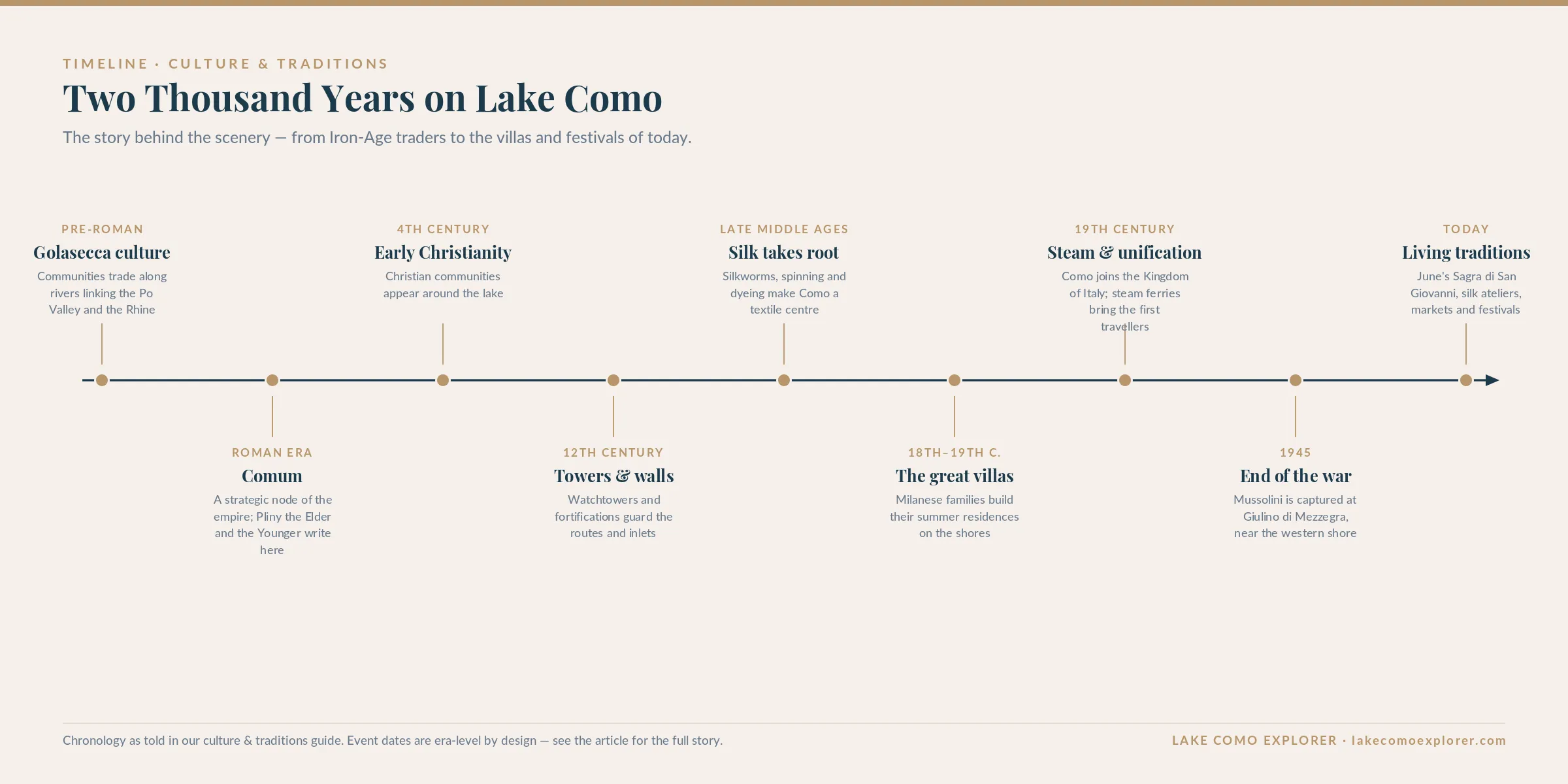
Long before luxury hotels and film stars, the Lake Como area was already a crossroads. Archaeological finds show that communities linked to the Golasecca culture lived not far from the basin, trading along rivers that connected the Po Valley and the Rhine. In Roman times the settlement of Comum, the ancestor of modern Como, became a strategic node where goods, people and ideas moved between the plains and the Alpine passes. Christian communities appeared by the 4th century, when early churches began to mark the lakefront and surrounding hills. Through the Middle Ages, fortified towers and stone villages grew up on each shore, while monasteries, tiny chapels and parish churches anchored religious life in even the smallest hamlets. By the 12th century, defensive structures and watchtowers guarded the main routes and inlets, and the lake witnessed both local rivalries and larger political struggles. During the 18th and 19th centuries, peace and prosperity allowed wealthy Milanese families to build summer residences along the water. These new villas opened onto geometric terraces and carefully designed gardens, while commerce and navigation continued to support working communities. Over time, steam ferries and new roads made it easier for visitors to arrive, and Lake Como slowly transformed from a practical transport corridor into a celebrated tourist attraction. The lake’s story is also preserved in texts. Pliny the Elder was born in Como, and his nephew Pliny the Younger owned villas on the lake that he described by name in his letters — an unbroken thread between ancient writing and the shoreline you see today. Together, these sources show how deeply this basin is woven into the narrative of northern Italian history.
2. The city of Como: walls, cathedral and inventors
The city of Como is the natural starting point for exploring culture around the lake. Its compact city center still follows the medieval grid, where narrow streets radiate from a lively piazza filled with cafés, shops and people meeting at all hours of the day. Walking a few minutes from the lakefront, you reach the old city walls, whose towers once guarded the city against enemies arriving by land or water. In the heart of the historic core stands Como Cathedral, also known as the Duomo di Como, one of the most important churches in Lombardy. The façade blends Gothic and Renaissance elements, and the interior is decorated with tapestries and more than one fresco that recalls key moments in Christian tradition and local history. Just by crossing the threshold you feel how religion, civic pride and art have long been connected in Como’s story. Science is another thread in Como’s identity. The city was the birthplace of Alessandro Volta, the inventor of the electric battery, whose experiments changed the world of physics. Museums and an exhibition space near the waterfront explain his discoveries and place them in the wider context of European science. As Como became part of the Kingdom of Italy in the 19th century and Como became more industrial, textile mills, workshops and new infrastructure reshaped neighbourhoods around Como while preserving older cores like Como’s walled centre. Today, towns like Como mix grand history with everyday life: children cycle through squares, office workers take a quick espresso at the bar, and visitors share the same streets as locals going to school, church or the weekly market. This blend of layers is part of what makes Lake Como feel lived-in rather than staged.

3. Sacred landscapes, chapels and historic events
Faith has always played a central role around Lake Como. High above the western shore stands the Sacro Monte di Ossuccio, a sanctuary complex with a string of small chapels dedicated to the mysteries of the Rosary. Each chapel shelters statues, reliefs and, in some cases, painted fresco scenes that bring biblical episodes into the everyday language of local people. The climb offers both prayer and stunning lake views over villages below. On a small island near this stretch of coast lies Isola Comacina, once a fortified settlement and religious centre. The island has seen churches rise and fall and was, for centuries, at the heart of power struggles between local lords and neighbouring cities. Today, paths and ruins recall those centuries of conflict and reconstruction, while a lakeside church and simple houses preserve a surprisingly serene atmosphere. Every June, the Sagra di San Giovanni lights up this part of the western shore. Boats process to the island for Mass, and after dark fireworks explode above the water in memory of battles that destroyed the settlement in the Middle Ages. The festival connects faith, history and spectacle in a way that is deeply rooted in local traditions, and it is one of the most atmospheric nights on the lakefront calendar. Lake Como has also played a role in more recent political history. In 1945, near the village of Giulino di Mezzegra, Benito Mussolini was captured and executed, an event that marked the end of a chapter for the Kingdom of Italy. Quiet lanes and chapels in this area remind visitors that beyond postcard scenes, the lake witnessed moments of intense national drama. Elsewhere on the basin, monasteries and sanctuaries tell their own stories. North of the mid-lake area, the abbey at Piona, originally a Cistercian monastery, preserves Romanesque architecture, cloisters and carvings that echo centuries of prayer and rural life. Scattered hermitages and a chapel perched on rocky outcrops complete a network of sacred sites that still draw pilgrims and hikers today.
4. Villas, gardens and lakeside elegance
For many travellers, Lake Como is synonymous with grand residences and manicured parks. Along both sides of the mid-lake basin, historic villas open their gates to the public at certain times of year, allowing visitors to step into salons, galleries and gardens that once hosted aristocrats, writers and statesmen. On the Tremezzina shore, Villa Carlotta combines art and nature in a way that defines local elegance. Inside, neoclassical sculptures and paintings line the staircases, while outside a botanical garden climbs the hillside in layers of camellias, rhododendrons and ancient trees. As you follow the paths, you move between shaded terraces and balconies with stunning lake views, understanding why this property became such a celebrated cultural landmark. Just across the water stands Villa del Balbianello, a villa originally commissioned by a cardinal and later transformed into a refined residence. Its arcaded loggia, clipped hedges and stone staircases are arranged to frame the water and mountains in every direction. Today the site is a major tourist attraction and has been featured in numerous films, yet the careful design still feels intimate when you walk its terraces. Further south, Villa d’Este near Cernobbio has welcomed royalty, politicians and artists for generations, with formal gardens, fountains and salons that open directly onto the water. In Como, Villa Olmo faces the lakefront promenade with a monumental façade and a park that now serves as a public green space, while its interior halls regularly host an art exhibition or cultural event. Together, these and other villas around the basin show how architecture, landscape design and social life have been intertwined for centuries. Smaller gardens and private homes also play a role in the character of towns like Bellagio, where stone staircases climb from the harbour and plant-filled balconies soften the fronts of old houses. This pattern continues in villages up and down the lake as informal versions of grand design, creating the intimate streetscapes that visitors remember long after their trip ends.
5. Silk production, work and craftsmanship
Behind the glamorous image of Lake Como lies a long tradition of work and craftsmanship. From the late Middle Ages onward, the mild climate and availability of water made the basin ideal for raising silkworms, spinning thread and dyeing fabrics. Over time, silk production moved from small workshops to larger mills, and Como became a recognised centre of textile innovation in Lombardy and beyond. The industrial era brought new machines, complex patterns and closer links with Milan, as Milanese merchants and designers commissioned fabrics for domestic and international markets. Even today, many fashion houses rely on the expertise of local technicians, dyers and weavers to translate their ideas into fabric. This network of artisan skill supports not just scarves and ties sold in boutiques, but also upholstery, accessories and experimental textiles used far from the lake itself. Modern visitors can still sense this heritage in museums and company archives that display sample books, looms and tools. The story shows how Lake Como area communities adapted to changing times while keeping a strong sense of quality and pride in their work. It also explains why a simple silk square bought in a shop by the harbour is more than a souvenir: it is a small piece of centuries-old craftsmanship.

6. Daily life, local traditions and local cuisine
Beyond villas and churches, it is the everyday rhythm of life that makes Lake Como feel distinctive. People meet in the piazza for coffee or an evening drink, catch up at the bakery, or chat on benches along the shore while children play nearby. Many families still keep strong ties to particular villages or valleys, and unique local customs survive in the way festivals are celebrated, how food is prepared and even how people greet one another. Food is central to these local traditions. Classic local cuisine includes freshwater fish such as perch and lavarello, served grilled or in creamy risotto, as well as more rustic dishes like missoltini, where small fish are salted, dried and later grilled with polenta. From the mountains come cheeses, cured meats and hearty stews, while desserts such as miascia bread cake or small nutty biscuits appear on many family tables. Eating in a simple trattoria on a quiet side street can reveal as much about culture as visiting a museum. Markets are another window into daily habits. Weekly local markets in towns like Como bring farmers, cheesemakers and street vendors together with residents shopping for fruit, vegetables and household goods. Strolling through stalls of seasonal produce, you see how the lake’s microclimate and surrounding valleys supply ingredients that appear in kitchens all year. Buying a snack or talking to a stallholder is one of the easiest ways for visitors to engage with local markets without feeling intrusive. On the water, life has also changed but not disappeared. Traditional fishermen are fewer than in the past, yet small boats still head out before dawn, and the silhouette of a boat crossing between villages remains a familiar sight. Regular ferries and smaller services connect communities, while private craft carry workers and visitors across the basin. Whether you take a simple public ferry or a guided tour, seeing daily routines from the water helps you understand how closely people depend on the lake. Spending a day walking through back streets, taking a short boat ride, stopping for an espresso in a bar full of locals and watching families stroll the lakefront at sunset gives you a sense of Lake Como’s character that no brochure can match. In these ordinary moments, Lake Como’s cultural depth becomes clear.
7. Seasons, festivals and the best time to visit
Because of its Alpine setting and particular geography, the lake experiences gentle winters and warm summers, with variations between north and south. Spring brings camellias and azaleas into bloom in villa gardens, while autumn colours the slopes above the shore in gold and red. For many, the best time to visit is late April to June or September to early October, when temperatures are pleasant, paths are open and crowds are lighter than in high summer. Each season carries its own rituals. In winter, life slows and many hotels close, but village festivals, Christmas markets and nativity scenes keep squares lively. In spring and early summer, regattas, processions and open-air concerts make evenings feel festive. Summer is peak tourism, when ferries are full and lakefront promenades are animated until late. Autumn harvest events, chestnut festivals and wine tastings reconnect residents with rural roots. These patterns create a yearly cycle that still structures social life. Understanding them helps visitors plan not just where to go, but when to come if they want a more serene experience of the lake. Travelling slightly outside peak months can reveal a quieter side of this northern Italian destination.
8. FAQs on culture and traditions of Lake Como
Is Lake Como only about scenery and luxury?
No. While the basin is famous for villas, hotels and stunning lake views, Lake Como’s identity is built on centuries of work, faith and community life. Fishing, farming, silk production and religious festivals have all shaped the way towns look and how people interact. Visiting churches, markets, small museums and less-known villages adds layers that a simple photo stop cannot provide.
What cultural sites should I prioritise if I have limited time?
If you have one or two days, combine a visit to the Duomo di Como and the waterfront in the city center with time at one or two villas such as Villa Carlotta, Villa del Balbianello, Villa Olmo or Villa d’Este. Add a walk at Sacro Monte di Ossuccio or a visit to Isola Comacina if you are interested in sacred landscapes, and allow at least an hour to sit in a café and watch everyday life unfold. This mix shows how religion, art, landscape and social life are interconnected around the lake.
How did Lake Como develop as a cultural and tourist destination?
The basin has been important since Roman times, when it linked the Po Valley and the Rhine. Over centuries, trade, monasteries and defensive structures shaped the shoreline. In the 18th and 19th centuries, aristocratic families and writers turned the basin into a fashionable retreat; later, easier transport and global visibility turned it into a modern tourist destination. The fact that it has attracted artists and writers and been featured in numerous films continues to reinforce its image today.
Are there any famous historical figures connected to Lake Como?
Several. In addition to Alessandro Volta, whose experiments transformed physics, the area has links to Roman authors and later political leaders. Historical accounts note how observers wrote about the basin, and more recent events such as the capture of Benito Mussolini near Giulino di Mezzegra show how national history has touched these quiet valleys. Together with religious sites and villas, these figures contribute to a layered sense of place.
How can I respectfully experience culture on Lake Como?
Small gestures go a long way: dress modestly when entering churches, speak quietly during services, and avoid blocking narrow streets when taking photos. When you visit a chapel or sanctuary, remember that it is often still a living place of worship. Supporting family-run businesses, choosing local guides and participating in cultural events rather than only seeking iconic viewpoints helps ensure that tourism supports communities. Taken together, these choices help protect what makes Lake Como’s character so distinctive.
Seen in this light, Lake Como’s story becomes far more than a backdrop for holidays. From ancient trade routes to modern villas, from sacred mountains to scientific discoveries, the basin offers a concentrated view of how landscape, work and belief shape human life. For travellers willing to slow down and look beyond the surface, Lake Como’s blend of history, faith, artistry and everyday routine offers one of Italy’s most rewarding cultural experiences.